
Remote IT support Helpdesk for Businesses Explained
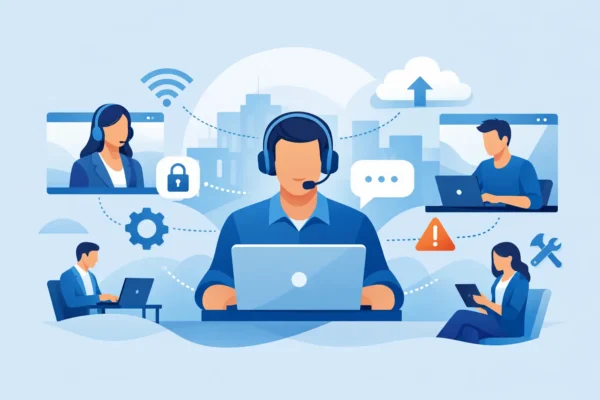
When a director cannot access Microsoft 365 five minutes before a client meeting, or a finance team loses access to a shared drive on payroll day, the problem is not just technical. It is operational, commercial and immediate. That is where a remote IT helpdesk for businesses proves its value – not as a nice-to-have, but as a practical way to keep people working and reduce disruption.
For many SMEs, the real issue is not whether support exists. It is whether support is fast, consistent and capable enough to solve problems before they spread. A remote helpdesk gives your team direct access to experienced engineers without the delay and cost of relying on ad hoc fixes or waiting for someone to drive to site for every issue.
What a remote IT helpdesk for businesses actually does
A proper remote helpdesk is far more than a phone number for when something breaks. It is the day-to-day support function that keeps users productive, systems available and recurring issues under control.
In practical terms, that usually means helping staff with password problems, Microsoft 365 errors, email issues, printer faults, connectivity problems, access permissions, software glitches, laptop performance, mobile device setup and a long list of other small but urgent disruptions. Many of these issues can be diagnosed and resolved remotely within minutes if the service is set up well.
That speed matters. A user locked out of their account for half a day is not a minor inconvenience when that person is customer-facing, processing orders or dealing with compliance-sensitive data. Remote support shortens the gap between problem and resolution.
It also gives businesses something they often lack with reactive support models – continuity. When the same support partner understands your users, systems, locations and business priorities, troubleshooting becomes quicker and advice becomes more relevant.
Remote IT Support is feasible with the wide variety of broadband access available today.

Why businesses are moving away from break-fix support
The old break-fix model can look cheaper on paper, especially for smaller firms trying to control overheads. You call when something goes wrong, someone fixes it, and you receive a bill. The weakness is that it treats IT as a series of isolated incidents rather than an operational system that needs attention every day.
That approach tends to create hidden costs. Staff lose time chasing updates. Small faults become bigger outages. Security gaps sit unnoticed. Technology decisions get made under pressure rather than with a plan behind them.
A remote helpdesk changes the relationship. Instead of paying only for emergencies, you have an accessible support function that deals with issues early, monitors patterns and feeds into wider IT planning. For business owners and operations teams, that usually means fewer surprises and a clearer sense of what is happening across the estate.
There is still a trade-off to consider. Not every business needs the same level of support cover, reporting or strategic input. A ten-person office using mostly cloud systems will need something different from a multi-site company with line-of-business applications, on-site networking and compliance obligations. The right service depends on complexity, risk and how costly downtime is for your organisation.
Where remote IT support works best – and where it does not
Remote support is highly effective for a large share of day-to-day IT issues. User access problems, cloud platform support, software configuration, security checks, email troubleshooting and many device-related faults can often be handled without an engineer needing to attend in person.
That makes it especially useful for businesses with hybrid teams, multiple sites or offices that do not justify a full in-house IT department. It also helps organisations that want quick support without the overhead of employing internal first-line staff.
That said, remote IT support is not the answer to everything. Physical cabling faults, failed hardware swaps, office moves, network cabinet work and some infrastructure installations still require someone on site. The strongest service model is usually a blend of remote helpdesk capability and on-site engineering when needed.
For that reason, businesses should be wary of providers that position remote support as a complete replacement for practical, hands-on IT delivery. It works best as part of a wider managed service, not as a narrow call-center function.
The business case for a remote IT support helpdesk for businesses
The obvious benefit is speed. Staff can report a problem by phone, email or ticket and get help quickly, often through remote access tools that let engineers see the issue first-hand. Faster response means less downtime, fewer interruptions and less frustration for employees.
The less obvious benefit is management visibility. A good helpdesk does not just solve tickets. It identifies recurring problems, flags ageing hardware, spots licence issues, highlights cyber risks and shows where processes need tightening. That turns support from a reactive cost into a source of operational insight.
There is also a staffing advantage. Recruiting and retaining internal IT people is expensive, and for many SMEs it is difficult to justify a full team with broad enough expertise. Remote helpdesk support gives access to multiple skill sets without carrying the cost of several permanent hires.
From a cyber security point of view, the helpdesk often acts as an early line of defence. Users report suspicious emails, unusual account activity or device concerns to a team that can investigate quickly. That matters because many security incidents are first noticed by staff, not monitoring systems.
What good remote IT support helpdesk looks like
Business leaders should expect more than polite ticket logging. Good support is responsive, commercially aware and able to speak plainly. Your users should not feel they are battling a script reader who does not understand the urgency of the issue.
A strong provider will set clear expectations around response times, escalation routes and service coverage. They will explain what is included, what happens when an issue needs on-site attention, and how support ties into wider infrastructure, cyber security and business continuity.
They should also understand your business context. A problem affecting a reception desk, warehouse system or practice management platform may need a different response from a single-user printer issue. Prioritisation matters because not all tickets carry the same operational risk.
Human support matters too. Businesses often come to outsourced IT providers after poor experiences with slow response, repeated handoffs or vague communication. Real people who answer promptly, take ownership and keep users updated make a measurable difference to confidence and continuity.
Questions to ask before choosing a provider
Before committing to a remote IT Support helpdesk, ask how the service is delivered day to day. Find out who answers the calls, how tickets are prioritised, what remote tools are used and whether support is UK-based. Ask how they handle Microsoft 365, cyber security concerns, user onboarding, leavers, device management and recurring incidents.
It is also worth asking what happens beyond support tickets. Can they advise on upgrades, cloud migrations, compliance requirements and resilience planning? If your provider only fixes isolated faults but cannot help shape your wider IT roadmap, you may still end up juggling multiple suppliers.
Look for evidence of consistency. Service metrics, client retention, sector experience and a clear process for onboarding all help. So does the ability to provide both remote and on-site support when your business needs it.
For organisations across the Midlands and beyond, this is often where a service-led partner stands apart from a basic helpdesk supplier. Nubis 365, for example, positions support as part of an ongoing relationship rather than a queue-based transaction. That model tends to work well for businesses that want practical help today and better planning for tomorrow.
Remote IT support helpdesk support as part of business growth
IT support is sometimes framed as a background service, but growing businesses usually discover that support quality has a direct effect on performance. If your team cannot access systems reliably, if cyber concerns are not handled quickly, or if every office change becomes an IT fire drill, growth becomes harder than it needs to be.
A remote helpdesk gives structure to that day-to-day pressure. It gives staff a place to go, gives management oversight and gives the business a more dependable foundation for change. Whether you are adding headcount, moving premises, tightening compliance or shifting more of your estate into the cloud, responsive support reduces friction.
The best time to review your support model is not after a serious outage. It is when things are working well enough for you to make sensible decisions rather than rushed ones. If your current setup relies on goodwill, delayed call-backs or one person who knows where everything is, there is a strong case for something more dependable.
A remote helpdesk should make your business feel easier to run. If it does that consistently, it is not just support. It is part of how you protect time, maintain trust and keep moving forward.