
🔐 Protect Your Business from Cyber Threats with Nubis 365
The Modern Cyber Threat Landscape: Why Static Defenses Fail and How Proactive Security Saves Businesses
The paragraph you shared highlights a fundamental truth of the digital age: cybersecurity is no longer a set-it-and-forget-it IT checklist. It is a dynamic, fast-evolving battleground where attackers leverage human psychology, automated tools, and sophisticated evasion techniques to bypass traditional defenses.
For modern businesses, a single security breach can cause catastrophic operational downtime, millions in financial losses, and irreparable damage to brand reputation. To understand why a comprehensive strategy involving ITDR, MDR, SIEM, and a 24/7 SOC is necessary, we must unpack the mechanics of modern threats like phishing and scareware, and explore how advanced defensive frameworks work together to neutralise them.
- Part 1: Deconstructing the Modern Threat Matrix
To defend an enterprise effectively, security teams must understand not just what the threats are, but how and why they succeed. Attackers rarely rely on brute-force hacking anymore; instead, they exploit the weakest link in any security chain: the human element and identity.
The Evolution of Phishing: Deception at Scale
Phishing has evolved far beyond the easily detectable, grammatically flawed emails of the early 2000s. Today’s cybercriminals use high-fidelity social engineering to trick even tech-savvy users.
- SharePoint and Cloud Spoofing: Because businesses heavily rely on cloud collaboration platforms like Microsoft 365 and Google Workspace, attackers frequently spoof SharePoint, OneDrive, or DocuSign notifications. A user receives an email stating, “HR has shared the updated 2026 Q3 Bonus Structure via SharePoint.” Clicking the link takes them to a flawless replica of a Microsoft login page. Once they enter their credentials, the attacker steals their session tokens, bypassing standard Multi-Factor Authentication (MFA) via a technique known as Adversary-in-the-Middle (AitM) phishing.
- Urgent Financial and Software Alerts: Fake banking notifications regarding “unauthorised transactions” or critical software update prompts exploit a user’s panic. When a user acts out of fear or urgency, their critical thinking is compromised, leading them to hand over admin credentials or download a malicious payload disguised as a patch.
Scareware and Browser Exploitation
Scareware relies on psychological manipulation (fear, uncertainty, and doubt) to compel users to take actions they otherwise wouldn’t.
A common delivery mechanism involves compromised or malicious advertising networks (malvertising). While browsing a legitimate website, a user’s browser is redirected to a page displaying flashing red banners and alarmist text: “WARNING: Your PC is infected with 13 viruses! Click here to scan now.”
[ Compromised Ad Network ] ──> [ Malicious Browser Redirect ]
│
▼
[ “Your PC is Infected!” ] <── [ Scareware Pop-up Alert ]
│
▼
[ User clicks “Allow/Install” ] ──> [ Malicious Payload Executed ]
When the user interacts with the pop-up, the site often requests browser notification permissions. If allowed, the attacker can push persistent, malicious alerts directly to the user’s desktop even when the browser is closed. In worse cases, clicking the link downloads a “cleanup tool” that is actually a Trojan or an infostealer designed to harvest passwords, session cookies, and cryptocurrency wallets stored on the machine.
- Part 2: Moving from Passive Defense to Proactive Response
Traditional antivirus software and firewalls look for known bad signatures (like a specific virus file). However, modern attackers use unique, fileless malware or legitimate administrative tools already built into operating systems—a tactic called Living off the Land (LotL).
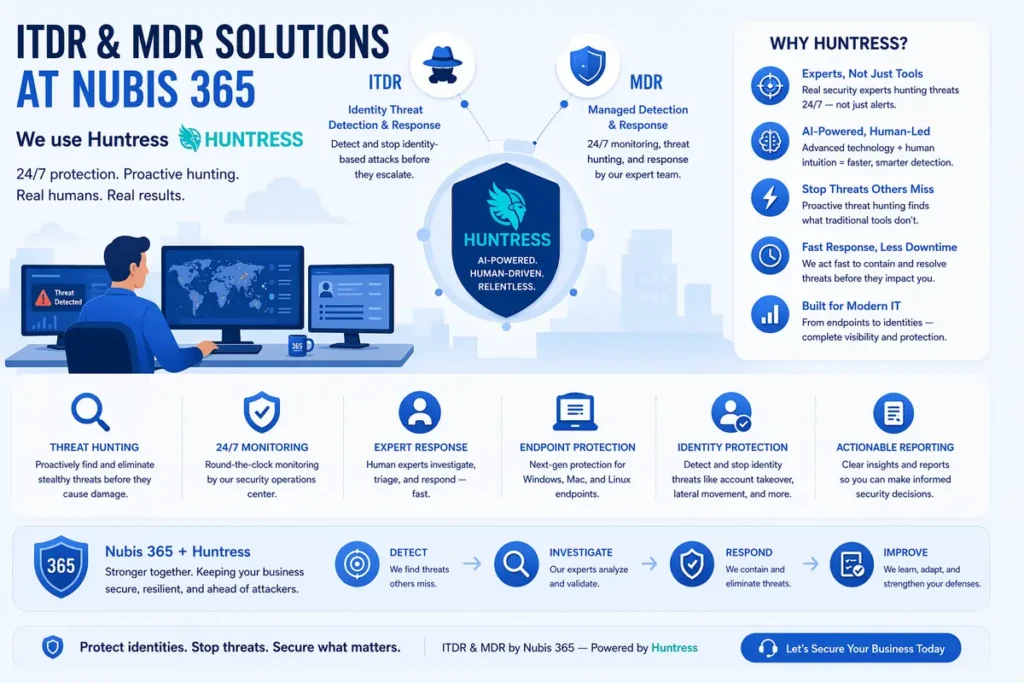
To stop these silent threats, organisations need specialised, behavioral-driven solutions: ITDR and MDR.
1. ITDR (Identity Threat Detection and Response)
In modern cybersecurity, identity is the new perimeter. Once an attacker steals a user’s credentials via phishing, they don’t need to “hack” into the network—they simply log in.
ITDR focuses entirely on protecting user accounts, privileges, and authentication infrastructure (like Active Directory or Okta). It constantly monitors for anomalous behavioral patterns related to identity:
- Impossible Travel: A user logs in from London, UK, and then logs in from Lagos, Nigeria, 15 minutes later.
- Privilege Escalation: A standard user account suddenly attempts to grant itself administrative permissions or access sensitive payroll directories.
- Credential Stuffing: Automated attempts to log into an account using thousands of leaked password combinations.
ITDR doesn’t just block unauthorised logins; it uncovers hidden vulnerabilities in an organisation’s identity architecture before attackers can exploit them.
2. MDR (Managed Detection and Response)
While ITDR protects the gateway (identity), MDR protects the environment as a whole—endpoints (laptops, servers), networks, and cloud workloads.
MDR is a fully managed service that uses advanced endpoint sensors (EDR tools) to monitor system behavior in real-time. If an employee accidentally downloads a scareware payload that begins quietly encrypting files or reaching out to a suspicious external Command and Control (C2) server, MDR detects the anomalous behavior rather than waiting for a known virus signature.
Crucially, MDR includes an active Response element. It allows security analysts to remotely isolate an infected laptop from the rest of the corporate network instantly, preventing a localised infection from turning into an organisation-wide ransomware disaster.
- Part 3: The Role of SIEM and Achieving ISO/IEC 27001 Compliance
For businesses aiming for enterprise-grade maturity or looking to win corporate contracts, compliance with international security frameworks like ISO/IEC 27001:2022 is vital.
The inclusion of a SIEM (Security Information and Event Management) tool provides the precise technical architecture needed to meet these stringent requirements.
Understanding SIEM: The Central Nervous System
An average business generates millions of digital data logs every single day across firewalls, routers, cloud applications, emails, and endpoints. Humanly analysing this data to find a hidden cyberattack is impossible.
A SIEM acts as a centralised brain. It ingests log data from every asset across your corporate infrastructure, normalises it, and runs it through a correlation engine.
[ Cloud Apps ] ──┐
[ Firewalls ] ──┼─> [ SIEM Aggregation Engine ] ──> [ Correlated Alert Generated ]
[ Endpoints ] ──┤
For instance, a single failed login on a laptop means nothing. But if the SIEM sees:
- A failed login on a laptop…
- Followed by a successful login from an unrecognised IP address…
- Followed by 5,000 files being copied to an external cloud storage drive…
The SIEM instantly correlates these separate events into a single, high-priority security alert.
Mapping SIEM to ISO/IEC 27001:2022 Annex 8.15
The ISO 27001 standard dictates how businesses must manage information security. The 2022 update introduced refined controls, including Annex 8.15 (Logging and Monitoring).
Annex 8.15 states that organisations must record event logs, protect them from tampering, and actively monitor them to detect unauthorised information processing activities. A SIEM tool directly fulfills this control by providing:
- Immutable Log Storage: Ensuring logs cannot be deleted or altered by a malicious actor trying to cover their tracks.
- Continuous Monitoring: Providing an audit trail that demonstrates to external ISO compliance auditors that your systems are actively watched.
- Incident Detection: Proving you have a programmatic method for identifying anomalies within those logs.
- Part 4: The Human Guard — The 24/7 Security Operations Center (SOC)
Software, no matter how intelligent or powered by AI, cannot defend a company on its own. Sophisticated attackers intentionally design threats to mimic legitimate business actions to trick automated filters. This is where a 24/7 Security Operations Center (SOC) becomes indispensable.
A SOC is a centralised team of human cybersecurity experts, threat hunters, and incident responders who work around the clock. When a SIEM or MDR tool flags a suspicious behavior at 2:00 AM on a Sunday morning, the alert doesn’t sit in an IT manager’s email inbox until Monday morning.
Instead, a Tier-1 SOC analyst immediately investigates it:
| Phase | Action Taken by the SOC Team |
| Triage | The analyst determines if the alert is a false alarm (e.g., an executive working late while traveling) or a true positive cyberattack. |
| Investigation | If it’s an attack, they trace the blast radius—how did the attacker get in, and what other machines have they touched? |
| Containment | The analyst executes immediate playbooks to kill the malicious processes, revoke compromised credentials, and isolate infected systems. |
| Remediation | The team cleanses the environment, closes the vulnerability that allowed the breach, and restores normal, safe business operations. |
A 24/7 SOC turns reactive panic into a controlled, professional containment procedure, minimising operational downtime and ensuring business continuity.
- Summary: Building a Unified Defense Matrix
The modern threat landscape requires a multi-layered defensive strategy where identity protection, endpoint monitoring, central log correlation, and round-the-clock human expertise overlap to eliminate blind spots.
By layering these distinct capabilities, organisations create a comprehensive security ecosystem capable of frustrating and defeating even the most persistent cybercriminals:
- Identity Layer (ITDR): Ensures that user accounts are locked down and that stolen credentials cannot be easily weaponised.
- Endpoint & Network Layer (MDR): Actively hunts for malicious behavior on laptops, servers, and networks, halting live attacks in their tracks.
- Visibility & Compliance Layer (SIEM): Aggregates millions of disparate data points into a clear operational picture while satisfying strict regulatory frameworks like ISO 27001 Annex 8.15.
- Expert Human Layer (24/7 SOC): Provides continuous oversight and decisive incident response, ensuring that defense mechanisms are always online and threat intelligence is acted upon instantly.
Taking advantage of integrated security offers—such as bundling critical visibility tools like SIEM alongside comprehensive detection engines—enables organisations to efficiently bridge the gap between basic IT security and robust, enterprise-grade cyber resilience.