
AI Impact on IT Support for UK Businesses
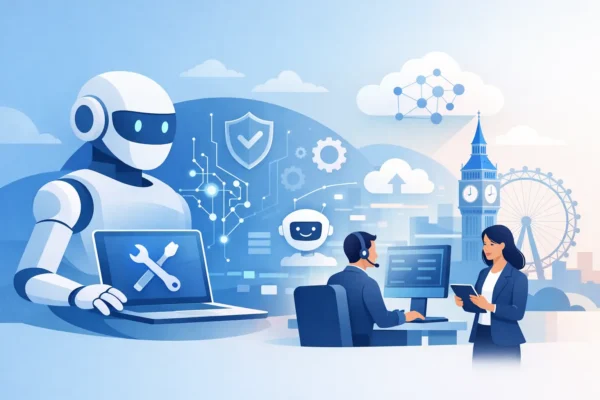
Monday morning. Half the office is logging back into Microsoft 365, someone cannot print, a director has been locked out of email, and a phishing message has landed in three inboxes. This is exactly where the AI impact on IT support becomes real for small and mid-sized businesses – not as a future concept, but as a practical shift in how quickly issues are identified, prioritised and resolved.
For many organisations, the question is no longer whether AI will affect IT support. It already does. The more useful question is what changes for your business, where the benefits are genuine, and where human expertise still matters most. If you rely on outsourced support or a managed IT partner, understanding that balance helps you make better decisions about service quality, cyber risk and day-to-day continuity.
Where the AI impact on IT support is already visible
The clearest change is speed. AI can analyse incoming tickets, recognise patterns, classify urgency and route issues to the right engineer much faster than a manual triage process. That matters when your team is trying to work and every minute of downtime carries a cost.
In a busy support environment, not every issue needs the same response. A password reset is not the same as a server outage, and a user struggling with Teams is not the same as a suspicious login alert. AI helps support desks sort that queue more intelligently. Done well, that means simpler issues are handled faster while more serious incidents reach experienced engineers sooner.
There is also a growing role for AI in spotting trends before users raise them. If several devices begin showing the same warning, or if login failures spike across a site, automated analysis can flag a developing issue early. For businesses with limited in-house IT resource, that kind of proactive visibility is valuable because it reduces the chance of a small fault turning into a wider disruption.
Faster service does not always mean better service
This is where the conversation needs a bit of realism. AI can improve efficiency, but efficiency on its own is not the same as support quality. If a system classifies a ticket wrongly, sends a user around in circles or offers generic advice that ignores the business context, the experience quickly becomes frustrating.
That is why the best use of AI in IT support is usually behind the scenes rather than as a full replacement for people. It can help gather information, recommend next steps and reduce admin for engineers. But when an issue affects operations, involves sensitive data, or needs judgement, businesses still want real people here to help.
A practice manager dealing with a clinical system issue, or an operations lead facing an internet outage across multiple users, does not want a scripted answer alone. They want clear guidance, ownership of the problem and confidence that someone understands the wider business impact. AI can support that process. It should not become a barrier to it.
How AI is changing the helpdesk model
Traditional support desks often spend a large amount of time on repetitive work. Resetting passwords, checking device health, closing duplicate tickets, gathering logs and confirming basic troubleshooting steps all take time. AI can reduce that burden.
That creates two important changes. First, engineers can spend more time on the issues that genuinely require technical judgement. Secondly, support providers can become more proactive because less resource is tied up in routine ticket handling.
For clients, the benefit is not simply a faster answer. It is a support model that has more capacity for improvement work, user guidance and strategic planning. If your IT partner is constantly firefighting, there is less room to advise on resilience, compliance, cloud performance or infrastructure planning. AI has the potential to free up that time, provided it is implemented sensibly.
There is a trade-off, though. If a provider leans too heavily on automation to cut service costs, clients can end up with a less personal service and slower escalation when something unusual happens. That is why businesses should look beyond claims about AI and ask how support is actually delivered. Who owns escalations? When does a human step in? How are exceptions handled? Those details matter more than the technology label.
AI impact on IT support and cyber security
Cyber security is one of the strongest areas for practical AI use. Modern environments generate too many alerts for manual review alone. AI tools can help identify suspicious behaviour, correlate signals across systems and highlight threats that deserve immediate attention.
For an SME, this can improve detection speed and reduce the risk of missed warning signs. Unusual login patterns, data movement anomalies and endpoint behaviour can all be assessed faster than a purely manual approach. In that sense, AI gives support and security teams a better chance of stopping problems before they spread.
But this is not a one-way advantage. Attackers are using AI as well. Phishing emails are becoming more convincing, social engineering is more polished, and fraudulent messages can be tailored with alarming speed. So while AI strengthens defence, it also raises the standard of what businesses need to defend against.
That means support teams must pair AI-driven monitoring with practical controls such as user awareness, patching, access management, email security and tested recovery planning. There is no tool that removes the need for disciplined cyber hygiene.
What business leaders should actually look for
If you are reviewing your current IT support, it helps to be practical about what good AI adoption looks like. It should improve responsiveness without making support feel distant. It should help identify issues early without flooding your team with noise. And it should support better decision-making, not just faster automation.
A dependable support partner should be able to explain where AI is used and why. That might include ticket triage, monitoring, knowledge suggestions, endpoint analysis or alert correlation. Just as important, they should explain where human engineers remain central. That is often in escalation handling, business-critical incidents, project planning, compliance conversations and user support that needs context.
For many organisations across the Midlands and wider UK, the right model is not AI versus people. It is AI plus accountable support. The technology handles repetition and pattern recognition. The service team provides ownership, communication and commercial judgement.
The effect on internal teams and end users
There is also a people side to this shift. AI can reduce the volume of simple interruptions landing on internal staff or office managers who end up acting as unofficial first-line support. If routine issues are resolved faster, users spend less time waiting and less time chasing updates.
At the same time, expectations rise. Once users get used to quick responses for simple requests, they expect the same speed everywhere. That can create tension when a more complex issue needs proper diagnosis, supplier liaison or on-site work. Good support providers manage this by setting clear expectations and communicating well, rather than letting automation create unrealistic promises.
For internal IT teams, AI can be helpful rather than threatening. In smaller organisations, there may be one technically minded person trying to cover everything from printers to cyber security. AI-backed support tools can reduce noise and help them focus on higher-value work. Yet they still need backup from experienced engineers when infrastructure, security or project demands go beyond what one person can reasonably manage.
What will matter most over the next few years
The biggest shift is unlikely to be a fully automated helpdesk. More likely, businesses will see support become more predictive, more data-led and more integrated with wider technology planning. Problems will be spotted earlier, routine tasks will be resolved faster, and service teams will have more information before they even pick up the phone.
That is useful, but only if it translates into better business outcomes. Faster issue resolution. Less downtime. Better cyber resilience. Clearer reporting. Smarter planning around Microsoft 365, connectivity, infrastructure and user support. Those are the results that matter.
For businesses choosing an IT partner, the test is simple. Does the service combine modern tooling with responsive, knowledgeable people? Can it support daily operations and long-term change? Does it make technology easier to manage, not harder to understand?
AI will keep changing IT support, and in many areas that change is positive. The businesses that benefit most will not be the ones chasing novelty. They will be the ones working with a partner that uses AI carefully, keeps service human, and stays focused on what support is there to do – keep your people productive, your systems secure and your business moving.