
Backup and Disaster Recovery Services Explained
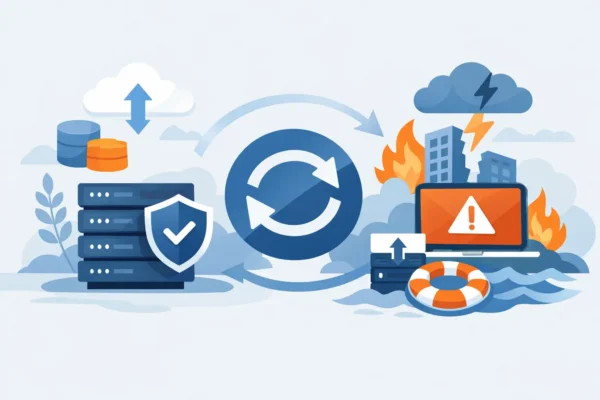
Protecting your business data is more important than ever. Data loss can happen due to accidental deletion, hardware failure, cyberattacks, or system errors. These incidents can seriously disrupt your operations. That’s why Nubis 365 offers secure and reliable backup solutions to keep your data safe and accessible. The blog post below explains in more depth how backup and disaster recovery services are vital for the continuation of your standard business practice.
A file server fails at 9:10 on a Monday. By 9:25, staff cannot access quotes, finance cannot process invoices, and customer calls start stacking up. That is the moment backup and disaster recovery services stop being an IT line item and become a business decision.
For small and mid-sized organisations, the real cost of downtime is rarely just technical. It shows up in missed orders, delayed projects, frustrated staff, reputational damage, and awkward conversations with clients who expected you to be available. The right approach is not simply storing copies of files somewhere else. It is building a clear, tested plan for how your business keeps operating when something goes wrong.
What backup and disaster recovery services actually cover
Backup and disaster recovery are closely linked, but they are not the same thing. Backup is about preserving copies of data so it can be restored. Disaster recovery is about getting systems, services, and people back up and running within a timescale your business can tolerate.
That difference matters. A business may have daily backups and still face a full day of disruption if restoring servers, applications, permissions, and cloud services takes too long. Equally, a fast recovery platform is only useful if the data inside it is current, complete, and recoverable.
In practice, backup and disaster recovery services usually bring together several layers. That can include endpoint backups for laptops and desktops, server backups, Microsoft 365 or cloud data protection, replication for critical systems, off-site storage, ransomware-aware recovery options, and documented recovery procedures. The service should also include monitoring, reporting, and regular testing. Without testing, a backup is really just a promise.
Why businesses get this wrong
Many organisations think they are protected because someone set up a backup job years ago. Often, that setup has not been reviewed since systems changed, staff moved to hybrid working, or the business adopted more cloud software.
There is also a common assumption that cloud platforms remove the need for backup. They do not. Microsoft 365, for example, provides resilience in the platform, but that is not the same as having your own independent recovery capability for deleted mail, corrupted files, accidental overwrites, or malicious activity.
The other issue is mismatched expectations. Directors may assume that “we have backups” means recovery will take an hour, while the actual process could take much longer. If nobody has defined acceptable downtime or data loss in advance, decisions are being made in the middle of a problem, when pressure is highest and clarity is lowest.
Backup and disaster recovery services for SMEs
For most SMEs, the best solution is not the biggest or most complex one. It is the one that reflects how the business actually works.
A practice handling sensitive documents may prioritise fast file recovery and retention controls. A warehouse or manufacturing operation may care more about restoring line-of-business systems quickly so operations do not stall. A multi-site business may need central oversight with local resilience. A company with remote staff may need stronger endpoint and cloud backup than traditional on-premise protection.
This is where a managed approach earns its value. Rather than buying tools and hoping they fit, the service is designed around your systems, your risk profile, and your recovery priorities. That usually starts with identifying what is critical, how long each service can be unavailable, and how much data loss is acceptable.
The two numbers that shape your recovery plan
Most backup and disaster recovery services are built around two measures: recovery time objective and recovery point objective.
Recovery time objective is how quickly a service needs to be back. Recovery point objective is how much data you can afford to lose, measured by time. If your finance system can be down for four hours but cannot lose more than 15 minutes of data, your solution needs to support both of those outcomes.
This is where trade-offs come in. Faster recovery and tighter recovery points usually cost more because they need more frequent backups, stronger infrastructure, or live replication. That does not mean every system needs top-tier protection. In fact, overprotecting low-priority systems can waste budget that would be better spent on genuinely business-critical ones.
A sensible provider will challenge assumptions here. Not every server needs instant failover. Not every file share needs to be retained forever. The right question is not “What is the most advanced option?” but “What level of resilience makes commercial sense for this business?”
What good backup and disaster recovery services look like
The strongest services are not sold as a product in isolation. They are managed as part of a wider continuity plan.
That means your backups are monitored every day, failed jobs are investigated, storage growth is reviewed, and changes in your environment trigger updates to the backup scope. It also means recovery procedures are documented in plain terms, so there is no confusion about who does what during an incident.
Testing is a major sign of quality. Restoring a single file is useful, but it is not enough. You also want test recoveries for servers, applications, user access, and cloud data. If a provider cannot show how recovery has been validated, you are relying on theory rather than evidence.
Security matters just as much. Backups must be protected from tampering, deletion, and ransomware. That can include immutable storage, separate credentials, multi-factor authentication, and network separation. If an attacker can encrypt your production systems and your backups at the same time, the backup strategy has a serious weakness.
When cloud, on-premise, or hybrid makes sense
There is no single model that suits every organisation. A fully cloud-based business may need strong protection for Microsoft 365, SharePoint, Teams, and user devices, with less focus on local servers. A business running specialist on-site applications may need image-based backups and rapid virtual recovery for local infrastructure. Many companies sit somewhere in the middle.
Hybrid setups are common because they match real business environments. You may have cloud collaboration tools, an on-site line-of-business server, remote users with laptops, and network equipment that still matters to day-to-day operations. Your backup and disaster recovery services need to reflect that mix rather than forcing everything into a single box.
The practical question is always the same: if a cyber attack, hardware failure, power issue, accidental deletion, or office incident happened today, what would be affected first, and how would you recover it?
The business case is not just about worst-case scenarios
Disaster recovery often gets framed around major incidents, but the everyday value is just as important. Staff delete folders. Updates fail. Devices are lost. Emails disappear. Databases become corrupted. Recovery services earn their keep in these smaller moments because they reduce disruption before it spreads.
They also support compliance, insurance expectations, and client confidence. If your business handles regulated data or works with customers who ask security questions during procurement, a clear backup and recovery position strengthens your answer. It shows that continuity is being managed properly, not left to chance.
For businesses without a large internal IT team, there is another benefit: clarity. A managed partner can turn a vague concern about resilience into a documented, supported service with real accountability. That is often far more valuable than a pile of software licences nobody owns properly.
Choosing a provider for backup and disaster recovery services
The key question is not whether a provider offers backup. Most do. The better question is whether they can align recovery with the way your business operates.
Look for a provider that starts with risk, systems, and commercial impact rather than jumping straight to tooling. Ask how often backups are checked, how recoveries are tested, what happens during an incident, and how cloud services are covered. Ask who you speak to when something goes wrong and whether support is handled by real engineers who understand your environment.
You should also expect honest conversations about limitations. Every solution has them. Budget, bandwidth, legacy applications, retention needs, and third-party dependencies all shape what is possible. A dependable IT partner will explain those trade-offs clearly and help you choose the right level of protection, not the most expensive one.
At Nubis 365, that practical mindset matters because resilience is not just about technology. It is about keeping your business moving, protecting your people from avoidable disruption, and making sure one bad morning does not turn into a much bigger problem.
If you are reviewing your current setup, start with a simple test: if a critical system failed this afternoon, how confident are you in what happens next? If the answer is anything short of certain, that is usually the right time to put a proper recovery plan in place.