
The AI Advantage: A Practical Guide to Transforming Your SME in 2026
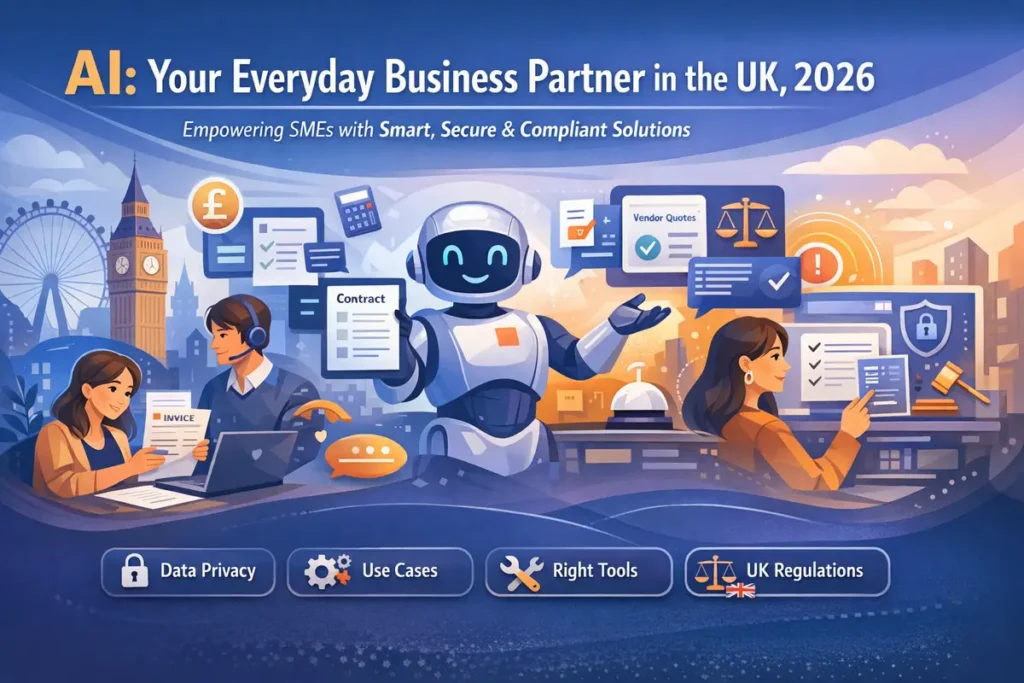
For Small and Medium-sized Enterprises (SMEs) operating in today’s fast-paced UK market, Artificial Intelligence (AI) is no longer a futuristic luxury reserved for tech giants; it is an accessible, everyday utility. In 2026, AI has evolved into a quiet co-worker—one that can process invoices, draft contracts, compare vendor quotes, and manage your reception, all while you focus on scaling your business.
However, integrating AI into your operations requires more than just buying a software subscription. It requires a strategic understanding of data privacy, specific use-case applications, choosing the right tools, and navigating the complexities of UK employment, financial, and company law.
This comprehensive guide will walk you through the practical benefits of AI for your SME, how to stay compliant with the UK-GDPR, a comparative look at the top AI models of 2026, and an expert Q&A on navigating the regulatory maze.
Data Protection First: Navigating UK-GDPR with AI
Before deploying any AI system, you must address the elephant in the room: data protection. AI models require data to function effectively, and if that data includes personal information about your clients, employees, or partners, the UK General Data Protection Regulation (UK-GDPR) strictly applies.
When integrating AI, SMEs must map the technology’s use against the seven core principles of the GDPR:
- Lawfulness, Fairness, and Transparency: You must have a clear, documented legal basis for processing data through an AI system. Furthermore, you must be transparent with your customers or employees if an AI is making decisions about them or processing their data.
- Purpose Limitation: If you collected customer data to fulfill an order, you cannot suddenly feed that data into a generative AI tool to train it to write marketing copy without obtaining fresh, explicit consent.
- Data Minimisation: Only feed the AI the data it absolutely needs to perform its specific task. If you are using an AI to summarize a client meeting, redact sensitive personal details (like national insurance numbers or home addresses) before processing the transcript.
- Accuracy: AI is known to occasionally “hallucinate” or confidently present false information. You must have human oversight (often called a “human-in-the-loop” approach) to ensure the AI’s outputs are accurate, especially when dealing with client records.
- Storage Limitation: AI systems should not become a black hole for your data. Ensure your AI vendors have strict data retention policies and that prompt histories are automatically deleted after a set period.
- Integrity and Confidentiality (Security): This is paramount. Ensure you are using enterprise-grade AI tools that do not use your proprietary business data or personal client data to train their public models.
- Accountability: As an SME owner, you are the data controller. You cannot outsource your legal responsibility to the AI vendor. You must keep records of your AI data processing activities and conduct Data Protection Impact Assessments (DPIAs) for high-risk AI deployments.
5 Practical AI Applications for the Modern SME (Using AI for the UK SME)
Once your data protection framework is secure, you can begin deploying AI to solve real-world operational bottlenecks. Here are five areas where AI is delivering immediate ROI for SMEs in 2026.
1. The Virtual Receptionist and Front-Line Triage
The days of the simple “press 1 for sales” automated phone tree are gone. Today’s AI receptionists use natural language processing to understand the nuance of customer inquiries.
- How it works: AI voice and text agents can answer calls, reply to website live chats, and monitor general inbox queries.
- The Benefit: They can instantly book appointments directly into your calendar, answer frequently asked questions about opening hours or services, and intelligently route complex, high-value queries to the correct human staff member. This ensures 24/7 customer service without the overhead of round-the-clock staffing.
2. Flawless Meeting Transcripts and Action Summaries
Countless hours are lost in SMEs simply trying to recall what was agreed upon in last Tuesday’s client meeting.
- How it works: AI meeting assistants integrate directly into video conferencing software (or operate via ambient listening in physical boardrooms).
- The Benefit: They do not just provide verbatim transcripts; they instantly generate executive summaries, identify key decisions made, assign action items to specific team members, and can even draft the follow-up email to the client. This transforms meetings from a time-drain into actionable workflows.
3. Quotation Comparisons and Procurement
Finding the best deal from suppliers often involves manually reading through wildly different quotation formats and trying to compare apples to oranges.
- How it works: You can upload multiple PDFs or emails containing supplier quotes into a secure AI workspace.
- The Benefit: The AI can instantly parse the unstructured data, extract the line items, and generate a standardised comparison spreadsheet. It can highlight hidden fees, compare warranty terms, and calculate the true total cost of ownership, allowing SME owners to make rapid, data-backed procurement decisions.
4. Streamlining Legal Documentation
Legal fees can be crippling for a growing SME. While AI does not replace a qualified solicitor, it acts as a highly capable paralegal.
- How it works: SMEs can use AI to draft standard non-disclosure agreements (NDAs), employment contracts, or basic terms of service based on established templates.
- The Benefit: When receiving a contract from a larger partner, an SME can ask the AI to summarise the liability clauses, highlight any non-standard indemnification terms, or identify missing standard protections. This dramatically speeds up the review process and reduces the billable hours required when you do eventually hand the document to your solicitor for final sign-off.
5. Automating Accounting Documentation
Manual data entry is the enemy of efficient accounting.
- How it works: AI tools are now deeply integrated into standard accounting software. When an employee takes a photo of a receipt or a vendor emails an invoice, the AI reads the document, extracts the vendor name, date, tax amounts, and total.
- The Benefit: It automatically categorises the expense based on your chart of accounts and flags anomalies (such as duplicate invoices or unusual spending spikes). This reduces human error, speeds up month-end reconciliation, and gives business owners a real-time view of their cash flow.
The 2026 AI Landscape: Which Model is Right for Your Business? (Using AI for the UK SME)
Choosing the right AI engine is crucial. In 2026, the market is dominated by a few major general-purpose players, alongside highly specialised tools and a robust open-source community. Here is how they stack up for SME use cases.
| AI Model / Family | Core Strengths for SMEs | Weaknesses / Limitations | Best Use Case |
| Microsoft Copilot | Deeply embedded in Microsoft 365. Crucially, data is generally more acceptable for sensitive information as it stays securely within your local Microsoft tenant and is not used to train foundational models. | Premium pricing per user. Requires your business to be fully invested in the Microsoft ecosystem to realise its true ROI. | Drafting Word documents; summarising Teams meetings securely; generating presentations from internal, sensitive business data. |
| Fireflies.ai | Purpose-built for conversation intelligence. Integrates seamlessly with almost all video conferencing platforms and automatically logs meeting notes directly into your CRM. | Narrowly focused (it is a specialised meeting assistant, not a general-purpose AI like ChatGPT). Accuracy dips if audio quality is poor. | Automating meeting transcripts; extracting action items from sales calls; updating customer records without manual data entry. |
| Gemini 3.1 Pro | Exceptional multimodal capabilities (processes video, audio, and images natively). Deep integration with Google Workspace. | Can be overly cautious with certain types of data analysis due to strict safety guardrails. | Creating marketing content from raw videos; drafting emails; daily workflow automation within the Google ecosystem. |
| GPT-5 Class Models | Unmatched general reasoning and highly versatile. Massive ecosystem of custom instructions and enterprise integrations. | High operational cost for API heavy usage. Can sometimes prioritise fluid text over strict factual adherence if not prompted correctly. | Complex strategy brainstorming; analysing large datasets; acting as a comprehensive general-purpose business assistant. |
| Claude (Opus/Sonnet line) | Massive context windows (can read entire books or massive codebases at once). Extremely strong at nuanced legal/technical reading. | Lacks the native internet search fluidity of Gemini; ecosystem integration requires more technical setup. | Reviewing long legal contracts; comparing dozens of supplier quotes; deep analysis of comprehensive financial reports. |
| Open Source (e.g., Llama 4) | Total data privacy. You can run these models locally on your own servers, meaning no data ever leaves your company. | Requires significant IT expertise to set up, maintain, and secure. Hardware costs can be high. | SMEs handling highly sensitive medical, legal, or proprietary IP data where cloud processing is not an option. |
Expert Q&A: Navigating the Legal and Regulatory Maze (Using AI for the UK SME)
As an SME in the UK (with current operations in places like the East Midlands, Northamptonshire, and beyond), implementing AI requires careful adherence to domestic laws. Here, we address the critical questions at the intersection of AI and UK business regulation.
Q: Employment Law: Can I use AI to screen CVs and make hiring or firing decisions?
A: You must tread extremely carefully here. Under the UK-GDPR (Article 22), individuals have the right not to be subject to a decision based solely on automated processing if it produces legal or similarly significant effects on them. Hiring and firing absolutely fall into this category.
If you use AI to screen CVs, you must have a “human-in-the-loop” reviewing the AI’s recommendations. Furthermore, under the Equality Act 2010, you are strictly liable if your AI tool demonstrates bias (for instance, if it downgrades CVs from women because it was trained on historical data biased toward men). You must regularly audit AI hiring tools for discriminatory outcomes.
Q: Financial and Accounting Law: If an AI makes an error on my tax return, who is liable to HMRC?
A: You are. The liability never shifts to the AI or the software provider. HMRC’s stance is clear: directors of a company hold the ultimate statutory responsibility for ensuring that financial records and tax returns are accurate. AI should be viewed as a sophisticated calculator or an assistant, not an authorised accountant. If an AI miscategorises an expense resulting in an underpayment of Corporation Tax or VAT, the SME will be subject to the standard HMRC penalties for careless or deliberate inaccuracies. Always have a qualified human accountant review AI-prepared financial statements before submission.
Q: Company Law: Can I use AI to manage my statutory filings with Companies House?
A: Yes, for administrative efficiency, but the legal declarations remain yours. You can use AI to track filing deadlines, format accounts, and generate the text for your annual confirmation statement or director’s report. However, under the Companies Act 2006, company directors have strict fiduciary duties to exercise reasonable care, skill, and diligence. Relying blindly on an AI to generate a report that misrepresents the company’s position to Companies House would be a breach of those director duties, potentially resulting in fines, disqualification, or even criminal charges in cases of severe fraud.
Q: Intellectual Property Law: Who owns the copyright to the marketing materials, logos, or code generated by an AI for my SME?
A: This remains a highly complex area of UK law in 2026. Generally, if an AI generates a piece of work with minimal human input (e.g., you type “write a blog post about plumbing”), the resulting work may not qualify for copyright protection because it lacks a “human author.” This means competitors could potentially copy that AI-generated text without penalty. To secure IP rights over your materials, human employees must substantially modify, edit, and shape the AI’s output so that the final product reflects genuine human creativity and intellectual effort.
Q: Employment Law: Can I use AI to monitor my employees’ productivity?
A: Yes, but it is heavily regulated. The Information Commissioner’s Office (ICO) mandates that any workplace monitoring must be necessary, proportionate, and transparent. If you deploy AI to track keyboard strokes, read employee emails, or monitor screen time, you must conduct a Data Protection Impact Assessment (DPIA). You must clearly inform your employees about what is being monitored, how the AI makes assessments, and what the data will be used for. Covert AI monitoring is almost always illegal under UK law unless you suspect severe criminal activity.
Conclusion (Using AI for the UK SME)
The integration of Artificial Intelligence into your SME is not about replacing your workforce; it is about augmenting it. By automating repetitive tasks like meeting transcripts, data entry, and basic document review, you free up your team to do what humans do best: build relationships, think strategically, and drive growth.
However, as this guide demonstrates, embracing AI in 2026 requires a mature approach to compliance. By keeping data protection at the forefront, maintaining human oversight over financial and legal decisions, and choosing the right model for your specific needs, your SME can harness the full power of AI safely, legally, and profitably.