
The “Bargain” Trap: Why That Cheap Second-Hand iPad or iPhone Could Be a Paperweight in 2026
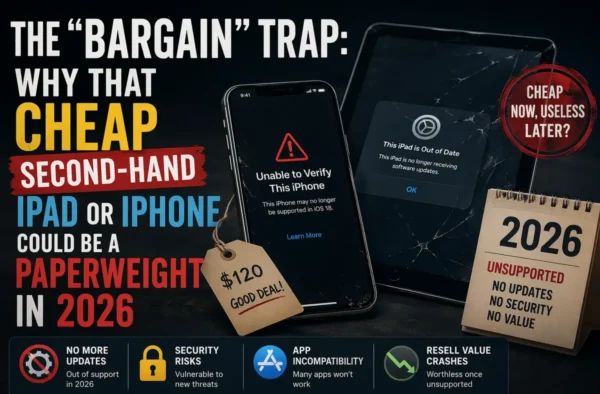
We’ve all been there—scrolling through eBay or a local marketplace and seeing an second hand iPad or iPhone for a “steal.” At first glance, it looks pristine, the price is unbeatable, and you’re ready to hit buy.
But in 2026, the mobile landscape has shifted dramatically. Buying older hardware isn’t just about a slower processor or a few scratches anymore; it’s about total obsolescence. Before you hand over your cash, here is why that “vintage” Apple device might be a massive mistake.
The 3G Sunset: Connection is No Longer Guaranteed
Many older iPads and iPhones rely on UMTS and HSPA (3G) as their primary or secondary data connection.
As of early 2026, major carriers (like EE, Vodafone, and Three in the UK) have completely switched off their 3G networks. If you buy a device that doesn’t support at least 4G LTE—or better yet, 5G—you might find that your “cellular” tablet is strictly limited to Wi-Fi.
The Risk:
Without 3G, older cellular modules simply won’t find a signal. You’re paying for a “Cellular + Wi-Fi” model that functions only as a “Wi-Fi” model.
The Missing Link: No NFC Means No Wallet
Check the specs carefully. Some older or budget-specific models list “Near Field Communication: No.” In a world where we pay for everything with a tap, an iPhone without NFC is essentially crippled
No Apple Pay: You cannot use it for contactless payments at grocery stores or transit hubs.
No Digital Keys: You won’t be able to use it to unlock modern cars or smart home locks that rely on NFC.
The Bottom Line: If the spec sheet says “NFC: No,” you’re stuck using physical cards or QR codes for everything.
The 5G Divide with your second hand iPad
If you are buying a second-hand device today, looking for 5G NR (New Radio) support is a must. While 4G (LTE and LTE Advanced) is still functional, network providers are prioritizing 5G bandwidth.
Congestion: In crowded areas, 4G bands are increasingly “throttled” or overcrowded as carriers move resources to 5G.
Battery Drain: Older LTE chips are less efficient than modern 5G modems, meaning your second-hand battery life will take a double hit: once from age, and once from inefficient connectivity.
SIM Compatibility: Physical vs. Digital
Modern devices now support eSIM alongside a Nano SIM. If you buy a very old model that only takes a physical SIM, you lose out on:
Travel Flexibility: You can’t easily download a local data plan when traveling abroad.
Dual Lines: You can’t have a work and personal number on the same device easily.
What to Look for Instead with your second hand iPad
If you’re determined to buy used, ensure the device hits these “Safe for 2026” benchmarks:
Connectivity: Must support LTE Advanced at minimum, preferably 5G.
NFC: Ensure it is marked “Yes” so you can use Apple Pay.
SIM: Look for eSIM support for future-proofing.
Network family: Ensure it supports WCDMA and GSM for global roaming, but never rely on them as your primary data source.
Final Verdict for your second hand iPad
That £100 iPad might look like a great deal for your kid or for reading the news, but if it’s stuck on HSDPA and has no NFC, you’re buying a device that is already halfway out the door.
Don’t buy a legacy headache. Check the specs, verify the cellular generations, and make sure your “new” old phone can actually survive in 2026.
| If you are… | Buy the cheap second Hand iPad ? | Why? |
| A regular user | NO | You’ll likely miss out on Apple’s 2026 AI features and contactless payments (if NFC is missing). |
| Using it for a kid | YES | If it’s just for YouTube and games on Wi-Fi, the “cellular” obsolescence doesn’t matter. |
| A business owner | NO | You don’t want to buy hardware that will be incompatible with your carrier’s 5G-only business plans by next year. |